Incarnation and the Descent into Form
To be human is to descend — consciousness enters limitation, the infinite enters boundary, and the body becomes the sacred threshold through which the Monad learns the dignity of form.
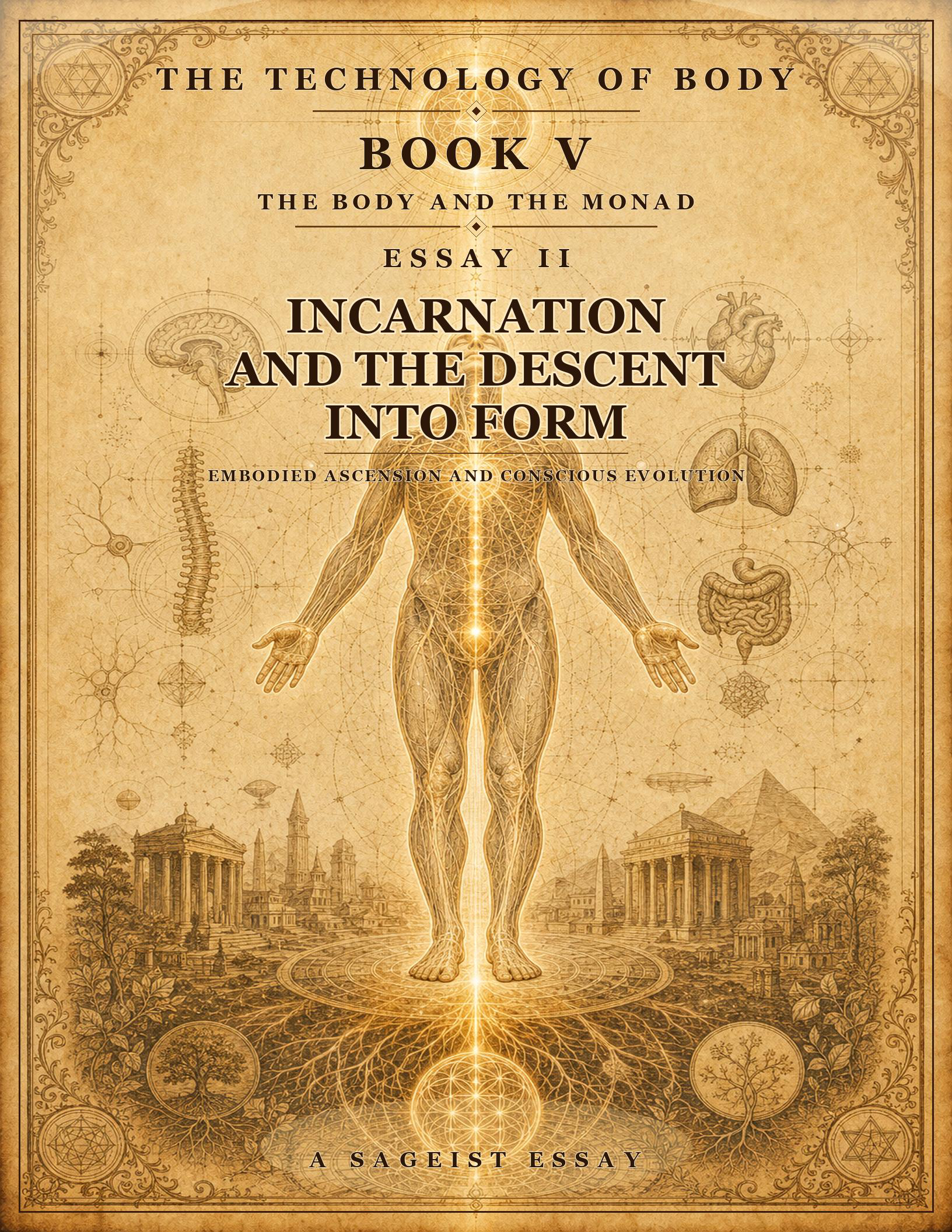
To be human is to descend. Consciousness enters limitation. The infinite enters boundary. The timeless enters time. The invisible enters matter. Birth itself is the great descent, the first initiation into density, breath, gravity, hunger, warmth, sound, touch, memory, and relationship. The Monad does not arrive as an abstraction. It arrives through a body.
This descent is often misunderstood. The modern world tends to imagine birth biologically and identity socially. It speaks of genetics, environment, family, culture, psychology, and history. These are real forces. Yet beneath them lies a more mysterious event: awareness enters form and begins to experience itself through limitation. A human life begins when consciousness is given location.
The Monad enters a world governed by gravity, biology, memory, and physical law. It enters a nervous system that must learn safety, a body that must learn coordination, a language that must learn meaning, a culture that must teach symbols, and a family that must teach relation. The descent is not punishment. It is participation. Consciousness enters the world so that existence can become intimate with itself.
The body becomes the threshold through which consciousness enters form. Without form there is no sensation. Without sensation there is no experience. Without experience there is no development. Without development there is no wisdom. The body therefore is not an obstacle to spiritual evolution. It is the condition that makes evolution possible.
Many traditions have treated the physical world as inferior. Matter became associated with corruption. The body became associated with weakness. Desire became associated with danger. Spirit became associated with escape. In this division, the human being was taught to look upward by rejecting the very ground through which the upward path becomes real.
Yet incarnation itself contradicts this contempt. Consciousness did not enter the body to despise embodiment. It did not enter matter merely to flee matter. It did not descend into time only to dream of timelessness. The descent into form reveals that matter is not meaningless. Matter is the field where invisible intelligence becomes consequential.
The doctrine of Sageism refuses the false war between spirit and body. The body is not the enemy of the Monad. It is the vessel of the Monad. It is the first temple in which the invisible becomes visible. The Monad without embodiment remains untested possibility. The body gives the Monad resistance, sensation, rhythm, hunger, affection, wound, effort, death, and choice.
Choice requires limitation. In pure abstraction, nothing must be chosen because nothing resists. In incarnation, every act has weight. A word can heal or injure. A meal can nourish or dull. A gesture can invite or close. A habit can liberate or imprison. A relationship can awaken or fragment. The body gives consequence to consciousness.
This is why limitation is sacred. Limitation is not merely restriction. It is the boundary through which meaning takes shape. A river needs banks in order to move. A flame needs fuel in order to appear. Music needs interval in order to become melody. The soul needs form in order to become human.
The descent into form begins with dependency. No human being enters life sovereign in the obvious sense. The infant arrives vulnerable, porous, unfinished, and relational. The body must be held before it can stand. It must be fed before it can choose. It must be touched before it can trust. It must be regulated by others before it can regulate itself. Incarnation begins not with independence, but with participation.
This dependency is not weakness. It is instruction. The Monad enters a world where nothing lives alone. Breath depends upon atmosphere. Blood depends upon food. Nervous systems depend upon contact. Psyche depends upon symbol. Culture depends upon memory. Civilization depends upon trust. The body teaches interdependence before philosophy can name it.
The first law of incarnation is therefore relationship. The body is not sealed. It exchanges continuously with air, light, temperature, food, sound, touch, bacteria, emotion, attention, and environment. To be embodied is to be in constant conversation with the world. The skin is a boundary, but not a wall. The human being is distinct, yet never separate.
The Monad learns through this exchange. It learns that reality is not an idea but a field of contact. It learns that love must become action, that truth must become speech, that courage must enter posture, that grief must enter breath, that forgiveness must enter behavior, and that wisdom must become design. Form demands embodiment from every inner claim.
A person may say they believe in compassion, but the body reveals whether compassion has become structure. Does the voice soften? Do the hands become less violent? Does the nervous system create safety? Does attention remain present when another suffers? Incarnation exposes the difference between idea and embodiment. The body is where philosophy becomes honest.
The descent also brings gravity. Gravity is not only a physical force. It is a spiritual teacher. It reminds the human being that height must remain connected to ground. It pulls abstraction back into weight. It asks every vision to find a footstep, every vow to find a discipline, every prayer to become conduct. Gravity does not oppose ascension. It protects ascension from becoming fantasy.
To stand upright is already a negotiation with gravity. The spine rises while the feet remain planted. The head turns toward horizon and sky while the body remains accountable to earth. This posture contains a doctrine. The human being is not meant to crawl beneath instinct, nor float above incarnation. The human being is meant to stand between worlds.
Book I revealed the body as the original technology. Book II revealed the nervous system as the operating system of consciousness. Book III revealed the body as living symbol. Book IV revealed initiation as embodied transformation. Book V now reveals the body as the field through which the Monad enters existence and learns the dignity of form.
Essay I asked who lives through the body. Essay II asks why consciousness enters the body at all. The answer is not possession. It is participation. The Monad does not inhabit flesh as a prisoner inhabits a cell. It enters form as a musician enters an instrument, as light enters a stained window, as meaning enters language, as seed enters soil.
The body is the instrument through which consciousness becomes audible. Breath becomes the first note. The heartbeat becomes the first rhythm. The nervous system becomes the first string of sensation. The bones become the frame of resonance. The hands become tools of prayer, craft, protection, and offering. The voice becomes the bridge between invisible thought and audible world.
Incarnation makes consciousness vulnerable. This is one of its deepest teachings. To have a body is to be exposed to pain, illness, aging, hunger, need, attachment, loss, pleasure, longing, and death. No philosophy worthy of the human being can bypass this vulnerability. The body opens the soul to consequence. It gives tenderness a reason to exist.
Without vulnerability there can be no courage. Without need there can be no care. Without mortality there can be no urgency. Without limitation there can be no discipline. Without separation there can be no reunion. The conditions that modern consciousness often tries to escape are the very conditions through which depth becomes possible.
The mistake is to confuse limitation with humiliation. Limitation does not degrade the Monad. It gives the Monad a world in which to mature. The finite does not insult the infinite. It reveals the infinite in a form that can be touched, tested, and transformed. The body is not the fall from spirit. It is spirit entering relationship with consequence.
Ancient initiatory systems understood this through trial. The initiate was not merely told truths. The initiate endured fasting, silence, pilgrimage, ordeal, posture, repetition, ritual, service, craft, and discipline. These practices forced truth out of abstraction and into the body. The initiate learned that wisdom must survive hunger, fatigue, fear, desire, loneliness, and responsibility.
Modern culture often avoids this because it prefers information without transformation. It collects language about healing, power, consciousness, identity, and evolution. But incarnation asks a more severe question: what has become embodied? What can remain true when the body is tired? What can remain dignified when the nervous system is pressured? What can remain loving when desire is frustrated? What can remain centered when the world becomes loud?
The descent into form is therefore not completed at birth. Birth begins the descent, but every serious human life must continue descending into the realities it would rather avoid. The person must descend into the body, into memory, into grief, into shadow, into responsibility, into ancestry, into service, into the consequences of desire, and into the demands of love. Spiritual maturity is not always ascent. Often it is a deeper descent into truth.
The body holds the records of this descent. It remembers the first environment before the mind can narrate it. It remembers whether touch felt safe. It remembers whether sound meant comfort or alarm. It remembers whether stillness was peace or danger. It remembers whether hunger was answered. It remembers whether crying called forth care or absence. Incarnation becomes biography before language begins.
This is why healing must be embodied. The Monad cannot simply think its way out of what the body learned through repeated contact. A nervous system shaped by fear must encounter safety, not merely the concept of safety. A body shaped by abandonment must experience reliable presence, not merely an argument for worthiness. A heart shaped by betrayal must learn trust through time, boundary, truth, and repair.
To descend into form is also to descend into lineage. The body does not begin from nothing. It carries ancestry, genetic inheritance, cultural memory, family pattern, food history, trauma, skill, beauty, survival, migration, and longing. The Monad enters not a blank instrument but an inherited one. Incarnation is personal, but never merely private.
The Sageist approaches ancestry without superstition and without reduction. The body carries biological inheritance, but it also carries symbolic inheritance. It receives gestures, fears, songs, recipes, posture, stories, prohibitions, prayers, names, silences, and expectations. A person may think they are living only their own life, while the body quietly repeats an older rhythm.
The descent into form asks the human being to become conscious of inheritance without becoming imprisoned by it. One must honor the line without being ruled by the line. One must receive the gifts without reproducing the wounds. The Monad enters lineage in order to transform lineage. The body becomes the altar where ancestry can either repeat or evolve.
Matter itself participates in this mystery. The body is made of earth elements organized into living intelligence. Bone is mineral architecture. Blood is water carrying fire. Breath is atmosphere entering rhythm. Nerve is lightning guided through flesh. Food becomes thought. Sunlight becomes vitality. Soil becomes memory. The body is the cosmos arranged as a person.
This is not poetic exaggeration. It is disciplined reverence. The human organism is not outside nature looking in. It is nature becoming aware of itself from within. The Monad does not enter a dead machine. It enters a living ecology. To honor incarnation is therefore to honor the earth that makes the body possible.
Civilization collapses when it forgets this. A disembodied civilization treats matter as resource only, land as inventory only, bodies as labor only, attention as commodity only, and technology as expansion without wisdom. Such a civilization does not understand incarnation. It extracts from the field that sustains it, then wonders why the human being becomes anxious, ill, lonely, and fragmented.
A civilization that remembers incarnation designs differently. It asks how buildings affect posture, how light affects mood, how food affects attention, how labor affects nervous systems, how media affects perception, how technology affects embodiment, how economics affects dignity, and how ritual affects coherence. It understands that every environment initiates the body into a way of being.
Architecture becomes a theology of form. A room can teach compression or expansion. A city can teach haste or orientation. A school can teach curiosity or compliance. A workplace can teach exhaustion or contribution. A home can teach regulation or vigilance. Since the Monad experiences the world through the body, environments become instruments of spiritual consequence.
The future human will need this literacy. It will not be enough to speak of consciousness while living in environments that fragment attention, inflame fear, degrade sleep, distort posture, overstimulate desire, and separate people from nature. The soul is not independent of its conditions in any simplistic sense. It can transcend conditions, but it is also shaped through them. Incarnation means context matters.
Technology must also be judged by incarnation. A technology that expands information while weakening embodiment is incomplete. A platform that connects minds while isolating bodies is incomplete. A machine that increases speed while eroding attention is incomplete. A system that magnifies power without deepening wisdom is dangerous. Wisdom must evolve faster than technology because technology acts through incarnate beings.
Artificial intelligence, digital systems, and future tools will test humanity's reverence for form. If consciousness is treated as data alone, the body will be viewed as obsolete. If intelligence is treated as calculation alone, embodiment will be dismissed as inefficiency. Sageism refuses this. The body is not outdated hardware. It is sacred infrastructure for experience, empathy, mortality, intimacy, intuition, and moral development.
The Monad learns through the resistance of real life. Digital abstraction can simulate worlds, but it cannot replace the full initiatory intelligence of hunger, touch, fatigue, breath, weather, labor, grief, eye contact, birth, illness, aging, and death. These are not defects in the human condition. They are the deep curriculum of incarnation.
To recover reverence for incarnation is not to idolize the body. The body is not ultimate. It changes. It suffers. It can mislead when appetite is ungoverned, fear is unintegrated, or chemistry is disturbed. Reverence is not worship of impulse. Reverence is right relationship. The body must be listened to, cared for, disciplined, interpreted, and integrated.
Discipline is essential because form requires order. A musician cannot honor an instrument by neglecting it. A temple cannot remain sacred if abandoned to decay. A body cannot become a clear vessel if constantly saturated with excess, distraction, resentment, stimulation, and disorder. Discipline does not oppose incarnation. Discipline allows incarnation to become luminous.
The body teaches through repetition. What is repeated becomes structure. What becomes structure becomes identity. What becomes identity becomes destiny. Therefore the descent into form asks the human being to choose patterns carefully. The Monad must learn to shape the very instrument through which it experiences the world.
Food becomes one layer of this shaping. Food is not only fuel. It is earth entering the body and becoming mood, thought, stamina, immunity, and perception. Breath is not only oxygen exchange. It is rhythm entering consciousness. Sleep is not only rest. It is restoration of the vessel. Movement is not only exercise. It is the re-patterning of perception through action.
The ordinary therefore becomes sacred. Washing the body, preparing food, walking, breathing, speaking, resting, listening, working, touching, and building are not outside spiritual life. They are the places where spiritual life becomes real. Incarnation means there is no wisdom that does not eventually touch the daily.
Sophia is present in this recognition. She is the intelligence that refuses to separate beauty from function, care from order, receptivity from strength, and environment from soul. Sophia teaches that form can be compassionate. She teaches that a body is not merely an instrument of will, but a living field requiring tenderness, rhythm, nourishment, and harmony.
Without Sophia, doctrines of spirit become hard. They demand ascent without care, power without beauty, discipline without listening, and transcendence without relationship. But the descent into form requires softness as well as strength. A body must be trained, but also held. A soul must be challenged, but also received. Civilization must be ordered, but also made beautiful enough for life to flourish.
The warrior current is also necessary. Incarnation exposes consciousness to appetite, fear, distraction, inertia, and seduction. The body can become temple, but it can also become prison if its patterns remain unconscious. The warrior protects the sacred threshold. He does not hate the body. He refuses to let unconscious forces govern it. He trains the vessel so consciousness can stand within it.
The union of Sophia and warrior creates mature embodiment. Sophia listens. Warrior acts. Sophia harmonizes. Warrior protects. Sophia receives. Warrior disciplines. Together they prevent the doctrine from becoming either sentimental softness or rigid domination. The incarnate human needs both tenderness and command.
The descent into form also explains why death is not an interruption to incarnation, but part of its architecture. Mortality gives life contour. Because the body ends, choices matter. Because time passes, attention becomes sacred. Because relationships are not guaranteed, love must be practiced. Death is not merely an enemy of life. It is the dark boundary that gives life urgency, humility, and proportion.
The awareness of death can either contract the person into fear or initiate the person into responsibility. The immature self asks how to avoid death psychologically. The initiate asks how to live so fully that the life becomes worthy of its limit. The body teaches this with every breath. Every inhalation receives. Every exhalation releases. The whole life is hidden in that rhythm.
The Monad does not need the body because it is incomplete in some crude sense. It enters the body because unity seeks expression. The seed enters soil not because seed is worthless, but because the hidden tree requires conditions. The note enters an instrument not because silence is false, but because music requires vibration. Consciousness enters embodiment because wisdom requires participation.
This understanding changes the meaning of spiritual ascent. Ascent is not escape from form. It is the refinement of form until consciousness can move through it with greater truth. The spine rises, but the feet remain. The breath deepens, but the lungs remain. The mind clarifies, but the body remains. The soul awakens, but relationship remains. The path upward is built through deeper embodiment.
The true descent is therefore circular. Consciousness descends into form. Form educates consciousness. Consciousness refines form. Refined form transmits consciousness. What begins as incarnation becomes initiation. The body first receives the Monad, then gradually becomes transparent to it. Presence is transmission because the body can learn to carry the center without distortion.
This is the meaning of the solar human. The awakened human does not reject flesh. The awakened human illumines flesh from within. Such a person does not need to announce spirituality constantly. Their presence regulates. Their speech clarifies. Their work orders. Their love dignifies. Their discipline frees. Their body becomes not spectacle, but sacrament.
The civilizational task is to build conditions in which more humans can become this coherent. Regenerative societies must be incarnational societies. They must respect sleep, food, movement, beauty, silence, ecological relation, meaningful work, healthy initiation, embodied education, relational repair, and technologies that serve rather than capture attention. The integrated human cannot be mass-produced, but civilization can stop manufacturing fragmentation.
Book V turns the doctrine toward this mystery: the Monad does not become human by avoiding form. It becomes human by entering form with increasing consciousness. The body is the doorway, the threshold, the instrument, the field, and the teacher. It is not the final identity, but it is the sacred means through which identity can be transcended responsibly.
Essay II closes with this recognition: the soul did not descend to escape life. It descended to experience life fully. The body is the sacred threshold through which consciousness learns itself. The descent into form is not a fall from divinity. It is divinity accepting weight, breath, memory, relation, and time so that wisdom may become embodied.
The gate closes here: incarnation is participation. Matter is not the enemy of spirit. Limitation is not the failure of consciousness. The human body is the place where the invisible agrees to become visible, where the eternal learns through time, and where the Monad enters the world not to flee it, but to illuminate it from within.